Five viewpoints, from the most accessible to the most remote, with real driving times — and the one piece of advice that counts: look at the sky before you leave. A panorama 1 hr 18 away in hazy weather is 2 hr 40 of driving for grey.
At a glance
Viewpoint | From the hotel | Access | What you see |
Saissac castle | 23.1 km · 26 min | short walk | the Lauragais plain, the Pyrenees |
Berniquaut oppidum | 29.7 km · 33 min | moderate walk | Sorèze, the plain, the north slope |
Castles of Lastours | 58.8 km · 52 min | steep 30-min climb | gorges, four castles |
Roquefère and the hamlets | 65.5 km · 1 hr 02 | variable | the valleys of the north slope |
Pic de Nore | 82.2 km · 1 hr 18 | by car | Pyrenees, Massif central, the sea |
Saissac — the best view-to-distance ratio
23.1 km · 26 minutes · short walk
The viewpoint to do if you only do one. And it is the one nobody talks about.
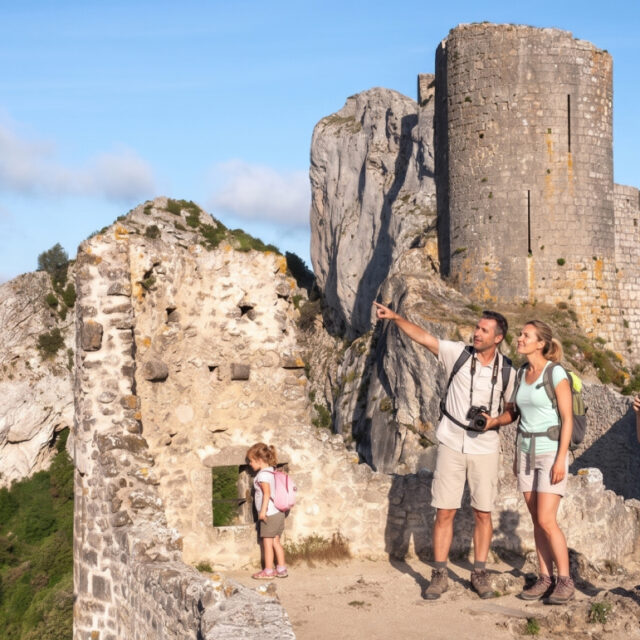
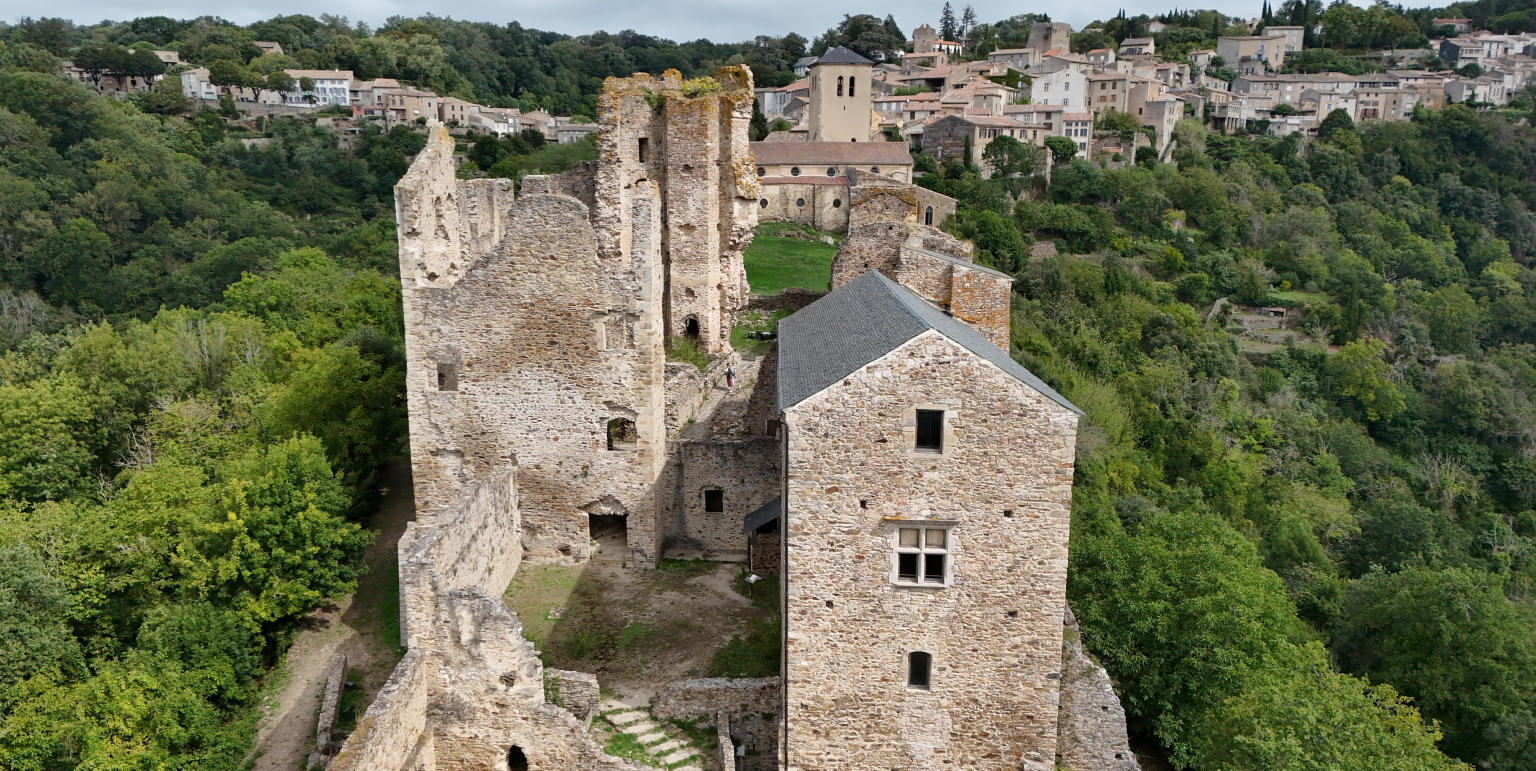
The ruined fortress stands as a balcony over the Lauragais plain, at the entrance to the Montagne Noire. From there, the eye runs down over the cultivated hills, the plain, and in clear weather the Pyrenees on the southern horizon.
Why it is the right choice: 26 minutes of driving. You can go in late afternoon, when the light rakes across the plain, and be back for dinner. No other panorama in the Montagne Noire offers that.
The bonus: it is also a historic site — a former stronghold of the Trencavels, viscounts of Carcassonne. See The finest Cathar castles.
The moment: late afternoon. The light rakes across, the plain takes on colour, and there is nobody there.
The Berniquaut oppidum — the best-kept secret
29.7 km · 33 minutes · moderate walk
A plateau above Sorèze, occupied since prehistory — an oppidum, that is, a fortified hilltop site, inhabited long before the Romans.
What you see: the plain on one side, the north slope of the Montagne Noire on the other. And above all: you understand why people settled here 2,500 years ago. You see everything coming.
It is the least visited viewpoint on the list, and one of the most interesting.
The pairing: Sorèze and its abbey school (30 min), then Revel (24 min) and its market hall.
Lastours — the panorama you earn
58.8 km · 52 minutes · steep 30-minute climb
It is not a viewpoint, it is a painting: four castles lined up along a rocky ridge, above two gorges.
The real viewpoint is the belvedere, opposite, from which you take in all four at a glance. That is where every photograph you have seen was taken.
What it costs: 52 minutes of driving and 30 minutes of steep climbing, on a stony path, with no shade. Closed shoes, water, and an early start before 11 am in summer.
What it is worth: it is the most spectacular landscape in the Aude, and it is under an hour away.
Roquefère and the north-slope hamlets — the most authentic
65.5 km · 1 hr 02
This is not a single viewpoint, it is a country: Roquefère, Labastide-Esparbairenque, Cubserviès — schist hamlets clinging to the valleys of the north slope, former villages of sawyers and foresters.
The viewpoints follow one another along the road: wooded valleys, slate roofs, streams. This is the least visited and the truest Montagne Noire.
The pairing: the Cubserviès waterfall (58.9 km, 1 hr 07), a drop of around 90 metres, one of the highest in France. But its flow depends on rainfall: in spring it is spectacular; in August after six weeks of drought, it is a trickle.
Go in spring.
Pic de Nore — the great panorama
82.2 km · 1 hr 18 · 1,211 metres · reachable by car
The highest point of the Montagne Noire. And the only place from which you see the entire geography of Languedoc: the Pyrenees to the south, the Massif central to the north, the Aude plain, and in very clear weather the Mediterranean.
You drive up to the relay station: no effort, just road.
Three things to know, and they are serious:
- It is a 2 hr 40 round trip. For a view. That is a decision.
- Only go up when the sky is clear. That is the absolute rule. In haze or in unsettled weather you will see nothing at all, and you will have lost the day. Look at the horizon from Castelnaudary before you leave: if you cannot make out the Montagne Noire sharply, do not go.
- Windproof jacket essential, even in August. It is 8 to 10°C cooler than Castelnaudary and the wind never drops along the summit ridge.
The best moment: after a spell of cers (the prevailing westerly), once it has scoured the sky. That is when the Mediterranean appears.
The alternative: in average weather, Saissac (26 min) already offers a superb view over the Lauragais, for 2 hours less driving.
Getting the photographs right
The light: early morning and late afternoon. In the middle of the day the plain is flattened and washed out, and nothing stands out.
Saissac: late afternoon, when the light rakes across the Lauragais plain. Lastours: mid-morning, when the sun lights the face of the castles from the belvedere. Pic de Nore: after the cers, when the air has been washed clean. It is the only time you see the sea. Cubserviès: in spring, when the waterfall is flowing.
The general rule: in this region, the wind is your photographic ally. The cers scours the atmosphere. The best visibility comes just after a windy spell.
From Le Clos Fleuri
The best viewpoint on the list is 26 minutes away — Saissac — which makes it a late-afternoon outing, not an expedition.
The furthest — Pic de Nore — is 1 hr 18 away, and it is only decided by looking at the sky in the morning. From Castelnaudary, you can see the Montagne Noire from the Cugarel windmill (2.2 km, 5 min from the hotel): if it is sharp, go up. If not, stay down.
That is a practical use of the location: you decide in the morning, by looking at the horizon, and adapt. A base 25 minutes away allows that; a night on the spot does not.