This article does not rank things by distance but by what you feel like doing. You know what you want — water, heritage, a view, local food, exercise, or nothing at all. Here is where to go in each case, without ever exceeding 15 minutes.
Water
The Saint-Roch locks — 1.7 km, 3 min, free
Four chambers in a row, about ten metres of height. A boat takes 40 minutes to work through the lot: you have time to follow the manoeuvre step by step from the towpath.
The chambers are oval. Riquet curved the walls so that the pressure of the surrounding earth acted in compression, as on an arch — the rectangular chambers of the 17th century collapsed. That is why these have stood for 350 years, and one of the reasons for the UNESCO listing in 1996.
The slot: 10 am-12 pm or 4-6 pm. Outside those, the reach is often empty.
The Grand Bassin — 1.9 km, 3 min, free
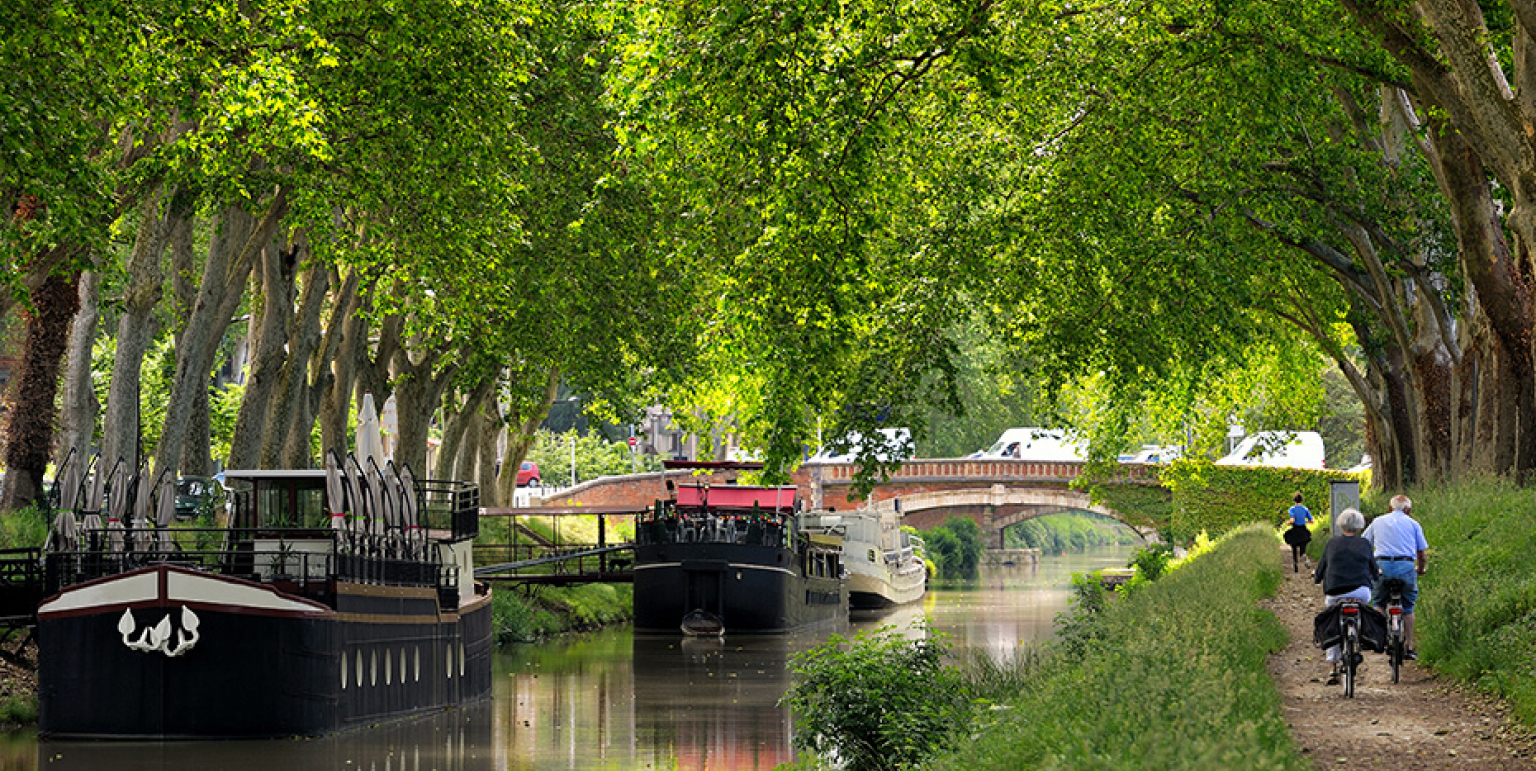
Seven hectares, the largest body of water on the Canal du Midi. A winter harbour and turning basin: long barges had to be able to come about.
A 2.5 km flat circuit, pushchair-friendly. The best moment is sunset.
A boat trip — departs from the Grand Bassin
A guided trip of 1 to 3 hours, or a licence-free boat for the day. The thing to check: choose a trip that passes through at least one lock. Going through a lock from the deck is the memory of the week; a trip along a flat reach is pretty and forgettable.
What to know: a canal boat does 8 km/h at most. In 6 hours you cover twenty kilometres there and back. It is not a means of transport, it is a pace. See Cruising on the Canal du Midi.
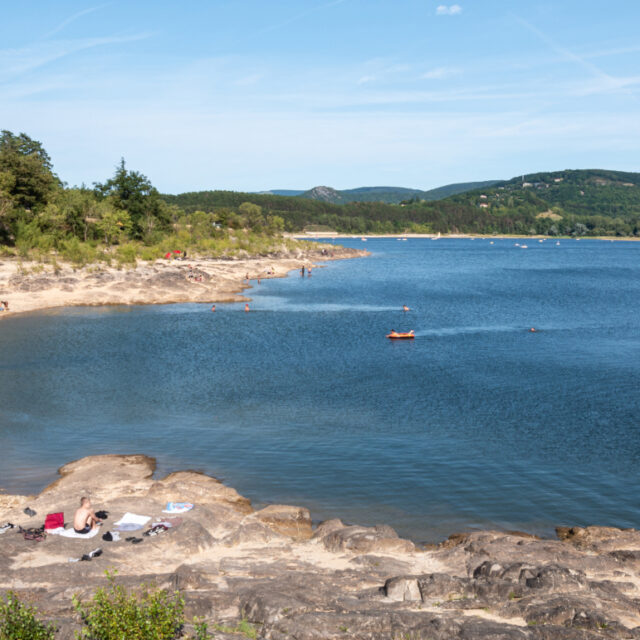
Swimming: forbidden in the canal. The nearest is Lake Saint-Ferréol, 25 minutes away — see Lake Saint-Ferréol.
Heritage
The collegiate church of Saint-Michel — 1.6 km, 3 min, free
13th-14th century, the landmark of the town.
The chapel of Notre-Dame-de-Pitié — 3 min, free
A 17th-century baroque interior behind a discreet façade. A five-minute visit. The most underrated site in Castelnaudary.
The Musée du Lauragais — 3 min
In the old Présidial (16th century). Wheat, woad, the canal: the economic history that explains the town. This is where you understand why there were thirty windmills on the hills.
Saint-Papoul abbey — 8.6 km, 10 min, ticketed
A former Benedictine abbey, a cathedral from 1317 to 1801. A cloister and sculptures attributed to the Master of Cabestany — one of the most interesting Romanesque sites in the département. 1 hr.
With children: hunt for the animals and monsters in the capitals. It works every time.
Opening periods differ from one site to another. Check with the Lauragais Audois Tourist Office.
The view
The Cugarel windmill — 2.2 km, 5 min, free
The last of the thirty-odd windmills of the Lauragais, the region’s granary.
From the knoll: the town, the plain, the canal, the Montagne Noire to the north and the Pyrenees to the south in clear weather. The only place from which the geography of the Lauragais makes sense at a glance.
Go on your first day. Everything else in your stay makes sense afterwards.
The practical tip: the wind almost always blows — that is why there were windmills. And it is also the spot from which to decide your day: if the Montagne Noire is sharp, head up there; if it is hazy, stay down in the plain.
The last 300 metres are steep. There is parking at the top.
Local food
Issel — 9.8 km, 11 min · Mas-Saintes-Puelles — 9.2 km, 14 min
The two villages that explain cassoulet.
The cassole — the conical earthenware dish that gave the dish its name — has been made there for centuries. This is not folklore: the porous clay regulates a slow cooking that nothing else reproduces, and the flared shape maximises the surface of the crust.
The Castelnaudary market — 3 min
Lauragais lingot beans, garlic, local honey, sheep’s and goat’s cheeses, artisan charcuterie, poultry, and seasonal fruit and vegetables. Parking is harder on market days: walk in.
Cassoulet — on site
Lauragais lingot beans, duck confit, sausage, pork rind and pork, slow-cooked in a cassole. At the restaurant of Le Clos Fleuri it is handmade, and the duck comes from a producer in the Montagne Noire.
Two hours, non-negotiable. This is not a dish you dispatch. Have it with a red from Cabardès or Malepère.
Getting moving
Cycling the towpath — start 3 min away
Flat, traffic-free. Two loops: – Around the Grand Bassin: 2.5 km, 30 min, from 4-5 years. – Upstream: 6 to 8 km there and back, from 8 years.
The surface is uneven — compacted gravel, earth, plane-tree roots. Hybrid or mountain bike, tyres of at least 35 mm. No road bikes. Helmets essential. After rain it stays muddy for 24 to 48 hours.
The Villeneuve-la-Comptal hills — 6.5 km, 9 min
5 to 7 km, 2 hr, ~120 m of elevation gain, and virtually no shade. In summer, before 10 am or after 6 pm.
The pool at Le Clos Fleuri — on site
An outdoor pool, a sun terrace, a garden. It is the answer at 3 pm in July, when the canal is baking and nobody feels like driving.
Doing nothing
It is an activity, and often the right one.
The garden and sun terrace at Le Clos Fleuri are on site. The Grand Bassin is 3 minutes away for a 40-minute stroll at sunset, with no effort and no decisions to make.
And the restaurant removes the worst moment of any stay: hunting for a table at 8 pm in a town you do not know.
And if you want to go a little further
| What you want | Where | Time |
| To understand the canal | Naurouze watershed — where the waters divide, 189 m | 17 min |
| A medieval village | Bram, a circulade | 18 min |
| Some history | Prouilhe, the first Dominican monastery (1206) | 18 min |
| To swim | Lake Saint-Ferréol | 25 min |
| A ruin | Saissac castle | 26 min |
| A fortress | Carcassonne | 34 min |