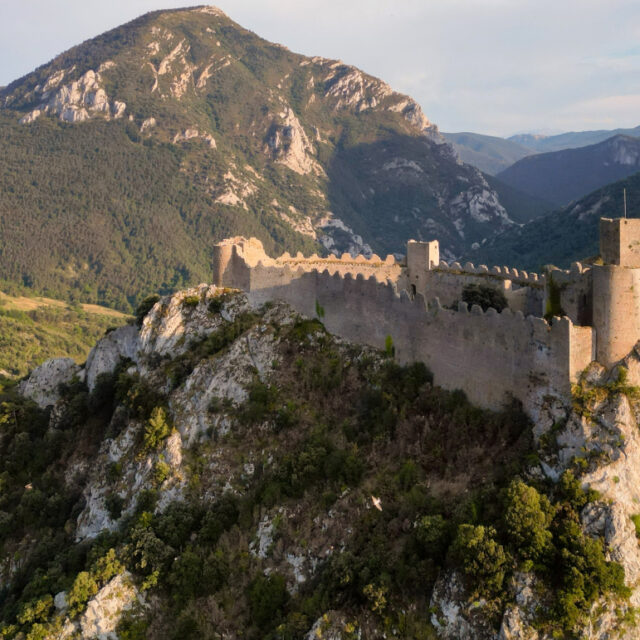
Three kilometres of ramparts, 52 towers, a double curtain wall. The walled city of Carcassonne is one of the largest fortifications in Europe and has been a UNESCO World Heritage Site since 1997. It is 43.7 km from Le Clos Fleuri, 34 minutes. Here is the route in the right order — the one that stops you walking the same loop three times.
The visit in five stages
Stage | Time | Ticket |
1. Porte Narbonnaise | 15 min | no |
2. Château Comtal, lices and wall walk | 1 hr 30 to 2 hr | yes |
3. Basilica of Saint-Nazaire | 30 min | no |
4. The back lanes, away from the shops | 45 min | no |
5. Porte d’Aude and the Pont Vieux | 45 min | no |
Total: 4 hr to 4 hr 30. Only one thing needs a ticket.
1. Enter through the Porte Narbonnaise
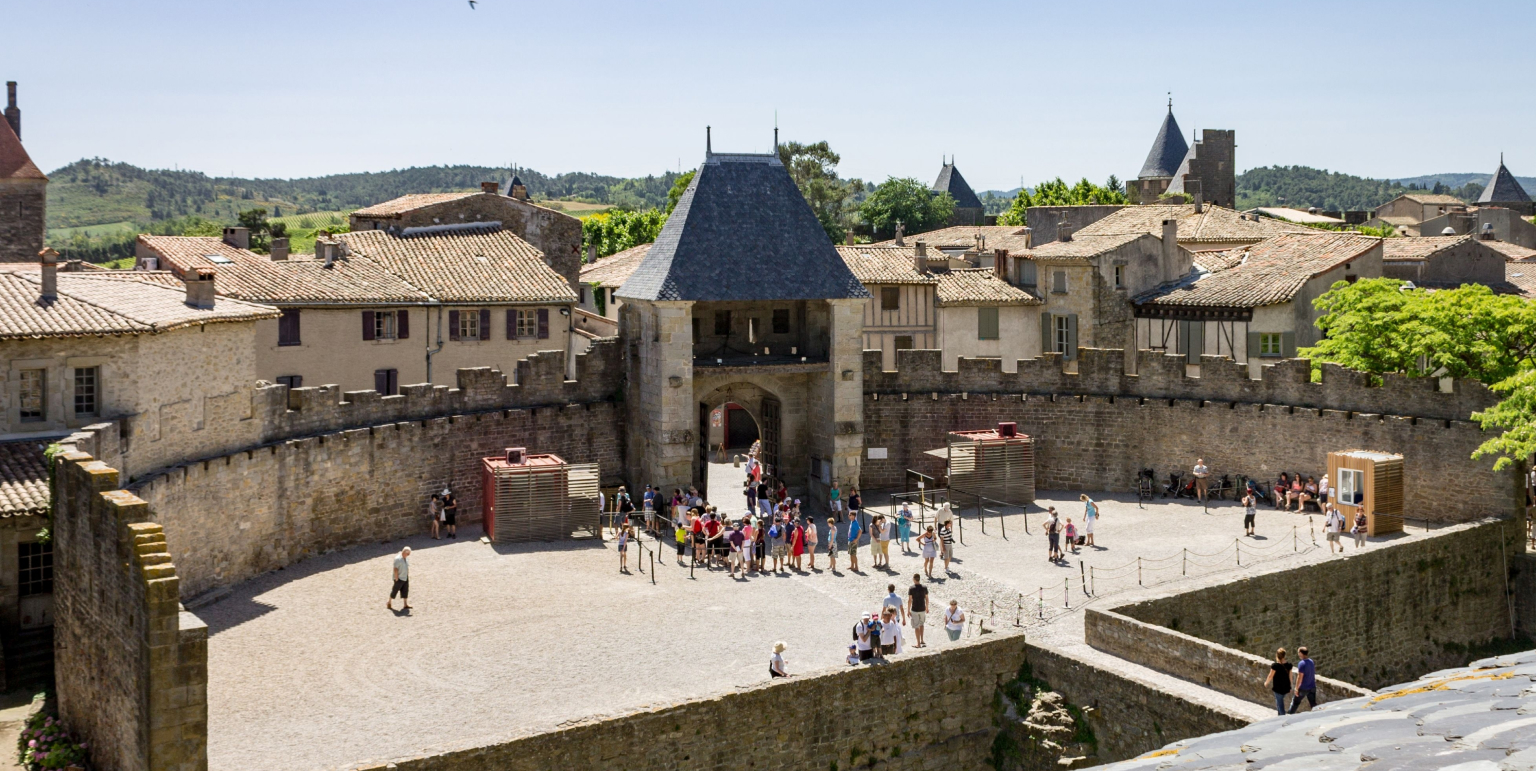
This is the eastern gate, the most monumental, framed by two spur-shaped towers. It delivers the shock of scale: you cross a double curtain wall, a bridge and a defensive corridor.
Take three minutes before you go in. Look at the double wall from outside: two concentric walls separated by a corridor. That is the whole principle of Carcassonne, and you will not see it as clearly again until you are down in the lices.
2. The Château Comtal and the lices — the heart of the visit
The only ticket you need. Book online in season.
The Château Comtal (12th century) is a fortress inside the fortress. That redundancy is not a whim: the castle served to hold the town as much as to defend it from outside — useful when you govern a population that did not choose you.
The ticket gives access to the wall walk and, above all, to the lices, the space between the two curtain walls.
Do not skip the lices. It is the only place from which the system makes sense: an attacker who gets over the outer wall finds himself trapped in a corridor, under fire from the inner wall. The outer rampart is lower than the inner one — deliberately, so that the defenders on the second can shoot over the heads of those on the first.
From the wall walk: the Bastide, the Aude plain, the Montagne Noire and, in clear weather, the Pyrenees.
Allow 1 hr 30 to 2 hr.
3. The basilica of Saint-Nazaire — the underrated site
Free. Thirty minutes. The finest moment of the day.
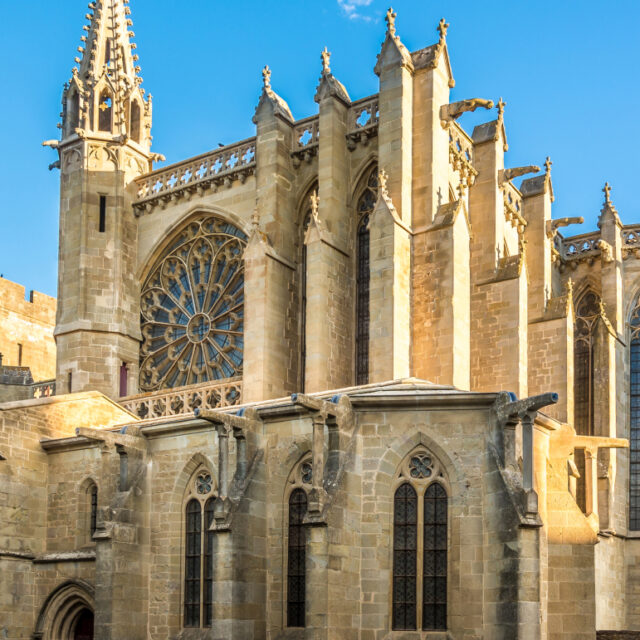
It sits away from the main flow, and that is exactly why it is worth the detour. Inside, two churches in one: a dark, massive, squat Romanesque nave to the west; a luminous Gothic chancel to the east. The contrast is stark and deliberate — one building site was stopped and another begun, two centuries later.
The 13th and 14th-century stained glass is among the finest in southern France. Come in the middle of the day, when the light passes through it.
4. The back lanes — as long as you leave the main axis
Between the Porte Narbonnaise and the castle, the main street is one souvenir shop after another. That is the price of success, and there is nothing to say about it.
The solution is one sentence: turn left or right. Two streets away there is nobody. Lived-in houses, courtyards, silence, and the true scale of a fortified village — because that is what it is: people live inside the walled city.
Allow 45 minutes of aimless wandering.
5. Leave through the Porte d’Aude
The finest way out, and almost nobody takes it.
The Porte d’Aude is the western gate. You come down a fortified zigzag ramp, hemmed in between the two curtain walls. Halfway down, turn around: this is the view of Carcassonne.
At the bottom, the pedestrian Pont Vieux (14th century) crosses the Aude. From the bridge, the whole city stands out on its spur. It is the best viewpoint, and it is free. In late afternoon the light rakes across the ramparts: that is when to be there.
What Viollet-le-Duc changed
You should know this before you go in, because it changes everything you look at.
In 1850, the walled city was a ruin slated for demolition. Viollet-le-Duc began restoring it in 1853 — and he did not merely consolidate: he reconstructed what he believed had once existed. The pointed slate roofs are his. Slate is not a Languedoc material; this region roofs in tile.
The debate has run for 170 years: restoration or reinvention? The honest answer is both. And without him, there would be nothing left to visit.
Look at the roofs knowing that. The visit becomes far more interesting.
When to go
9 am. That is it. At 9 am the ramparts are empty; at 11 am they are full. From Le Clos Fleuri, leaving at 8.15 am puts you there ahead of the coaches.
Late afternoon is the second option: the groups leave, the light turns golden, and the Pont Vieux comes into its own.
Summer: set off early. The lices are a shadeless stone corridor, and they get very hot in the afternoon.
From Le Clos Fleuri
Thirty-four minutes by car, about 20 minutes by regional train from Castelnaudary station (2.4 km from the hotel).
The point of sleeping in Castelnaudary rather than Carcassonne is simple: you arrive before the crowd instead of being in it, and you come back in the evening to a quiet town, 3 minutes from the Canal du Midi and its evening light. The hotel restaurant lets you end the day on a Castelnaudary cassoulet rather than a tourist menu.
Access conditions, prices and booking for the Château Comtal change. Check before your visit.
Got a question?
We are here to help
At 9 am, when it opens: the ramparts are empty before 10 am and packed after 11 am. From Castelnaudary, 34 minutes away, leaving at 8.15 am is enough.
Read also: What to do in Carcassonne in one day · Where to park in Carcassonne · The finest Cathar castles