Three days is the threshold. It’s the point at which you can add Montségur — and therefore the point at which Cathar history stops being a poster and becomes a chronology.
Here is the itinerary, in the order that makes sense: the context, then the two sides, then the end.
The structure
| Day | Theme | Driving |
| 1 | Castelnaudary and the Canal du Midi | ~40 km |
| 2 | Carcassonne — the context | ~90 km |
| 3 | Mirepoix and Montségur — the end | ~130 km |
You don’t change hotels. Everything is less than 1 hr 10 from the Clos Fleuri.
Day 1 — Castelnaudary and the Canal du Midi
The local day, everything under 17 minutes away.
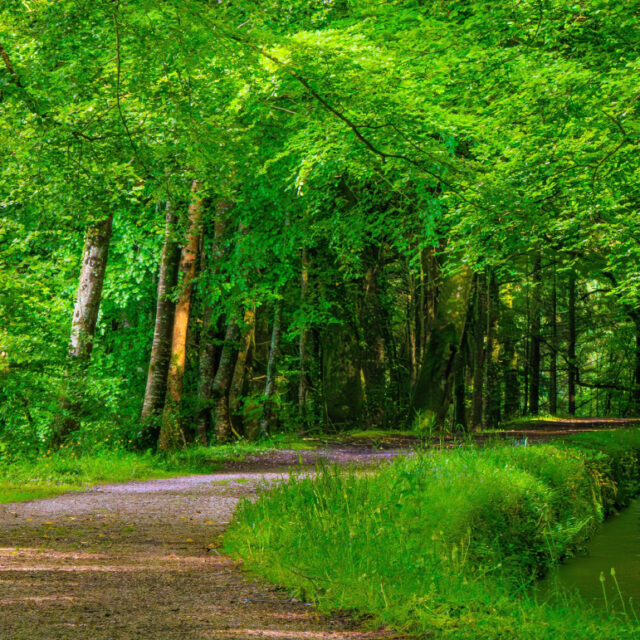
8 a.m. — Grand Bassin (3 min), mist on the water, nobody about. 7 hectares, the largest stretch of water on the canal. A 2.5 km loop. 9:30 a.m. — Historic centre (3 min): the Saint-Michel collegiate church, the Notre-Dame-de-Pitié chapel, the Lauragais museum. 10:30 a.m. — Cugarel windmill (5 min): the last of the thirty-odd mills. The plain, the Montagne Noire, the Pyrenees. 11:30 a.m. — Saint-Roch locks (3 min): four oval chambers — Riquet curved the walls to put them in compression, which is why they’ve held for 350 years. 12:30 p.m. — Cassoulet, two hours. 3 p.m. — Saint-Papoul abbey (10 min): a cathedral from 1317 to 1801, sculptures by the Master of Cabestany. 4:30 p.m. — Naurouze watershed (17 min): the point where the waters divide, 189 m.
See What to do around Castelnaudary in 24 hours.
Day 2 — Carcassonne, and why it’s day 2
43.7 km · 34 minutes
Don’t start with Montségur. Without Carcassonne, Montségur is a ruin with a good view.
This is where, in August 1209, after a two-week siege, Raymond-Roger Trencavel surrendered. He died in captivity three months later, aged 24. Simon de Montfort took the viscounty. Everything that follows — Lastours, Minerve, Montségur — flows from that moment.
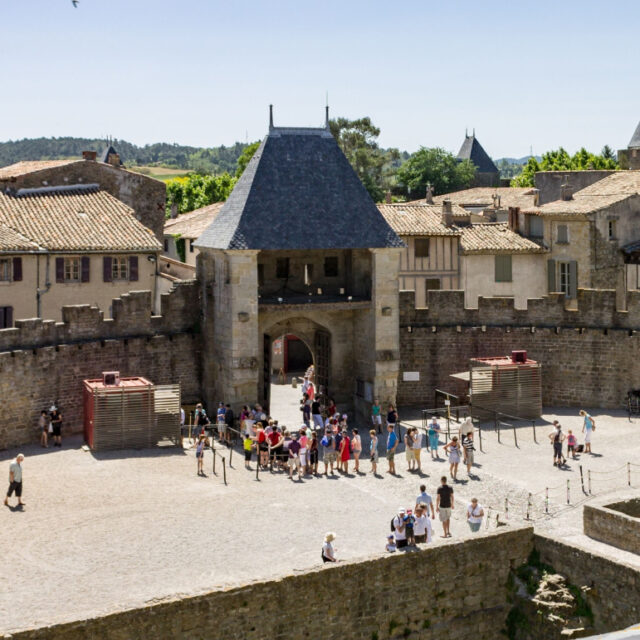
Leave at 8:15, on site by 9, empty ramparts. 3 km of ramparts, 52 towers, a double curtain wall, UNESCO 1997.
The Château Comtal and the space between the two walls (2 hrs) — that corridor is the only place from which the system makes sense: an attacker who gets over the outer wall is trapped in it, under fire from the inner wall, which is deliberately higher.
Saint-Nazaire basilica (free, 30 min): 13th- and 14th-century stained glass, among the finest in the South. A dark Romanesque nave to the west, a luminous Gothic choir to the east.
The back lanes off the main axis, the descent through the Porte d’Aude, the Pont Vieux (the best viewpoint, and free), the Bastide Saint-Louis.
And know this before you go in: in 1850 the Cité was a ruin slated for demolition. Viollet-le-Duc restored it from 1853 — and reinvented it. The pointed slate roofs are his, and slate is not a Languedoc material. The argument has been running for 170 years.
See Visiting the Cité de Carcassonne.
Day 3 — Two versions
Version A — Mirepoix and Montségur (the end of the story)
9 a.m. — Mirepoix (34 km, 38 min): one of the finest arcaded squares in the South-West, 13th- and 14th-century timber galleries, carved beams on the Maison des Consuls. 1 hr 30.
12:30 p.m. — Lunch at the foot of the pog of Montségur (64 km, 1 hr 10).
2:30 p.m. — Climb to Montségur. 30 minutes, steep.
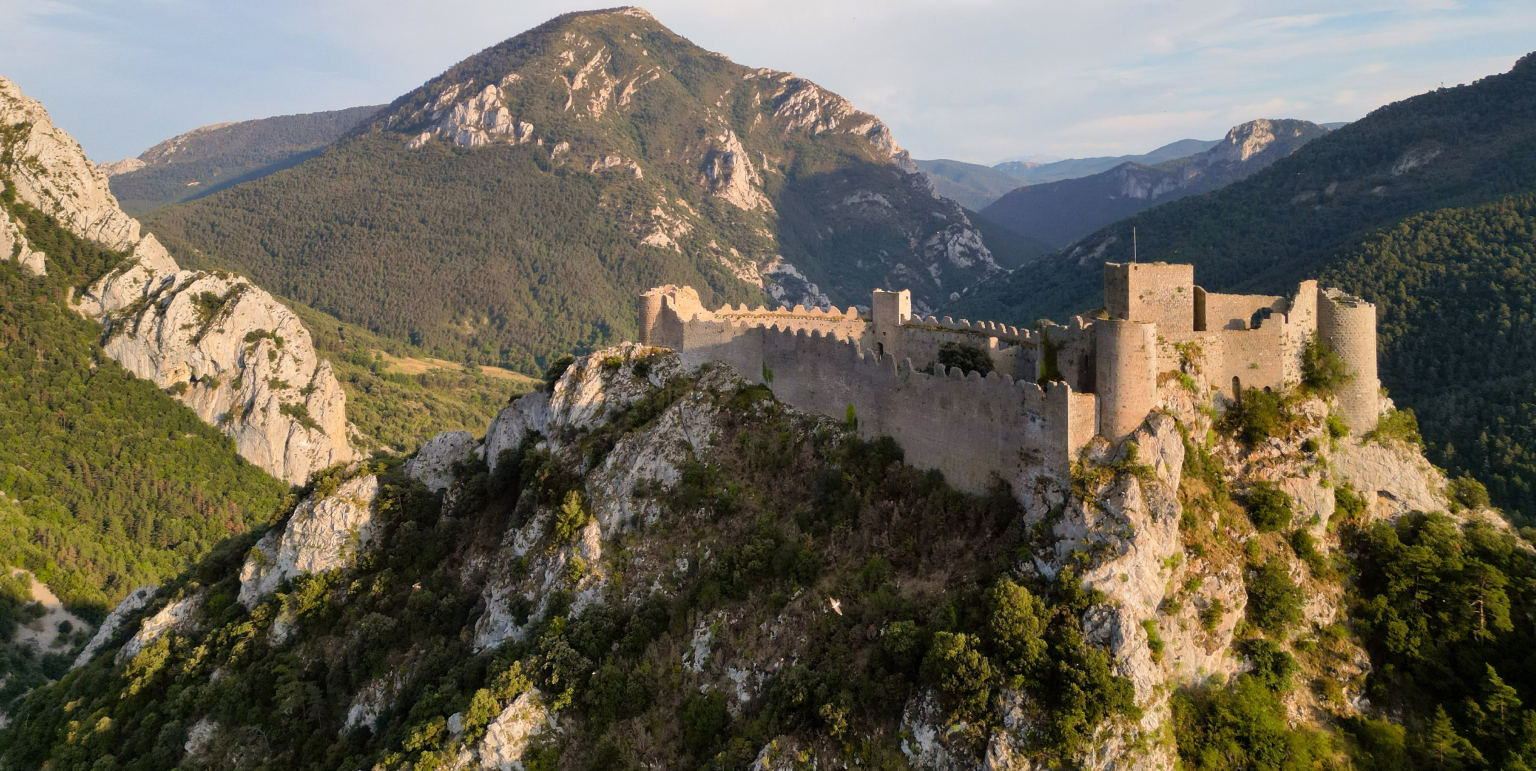
The siege of 1243–1244. Surrender in March 1244. Around two hundred Perfects burned at the foot of the pog, at the prat dels cremats. The military end of organised Catharism.
The detail that changes the visit: the castle you climb up to see is not the one from the siege. The castrum was razed after the surrender; what you see is a royal reconstruction. The place is authentic, the walls are not.
5 p.m. — Return, 1 hr 10.
Version B — Saissac, Montolieu and Lastours (the two sides)
9 a.m. — Saissac (23.1 km, 26 min): a ruined fortress, a former Trencavel stronghold, overlooking the Lauragais. 11:30 a.m. — Montolieu (26.9 km, 34 min): the book village. Lunch. 2:30 p.m. — Lastours (58.8 km, 52 min): four castles on a single ridge. Cabaret held out against Montfort and surrendered in 1211. The Régine tower came later: the King of France built it once the site had fallen.
The two sides fifty metres apart, on the same ridge. Nowhere else is the history this legible in the stone.
A steep 30-minute climb. Closed shoes, water, no shade.
Which to choose? Version A if you want the place of memory. Version B if you want to understand. Version B is also the less tiring: 2 hrs of driving against 2 hrs 30.
The food side of things, in between
Three days of driving and climbing deserve some compensation.
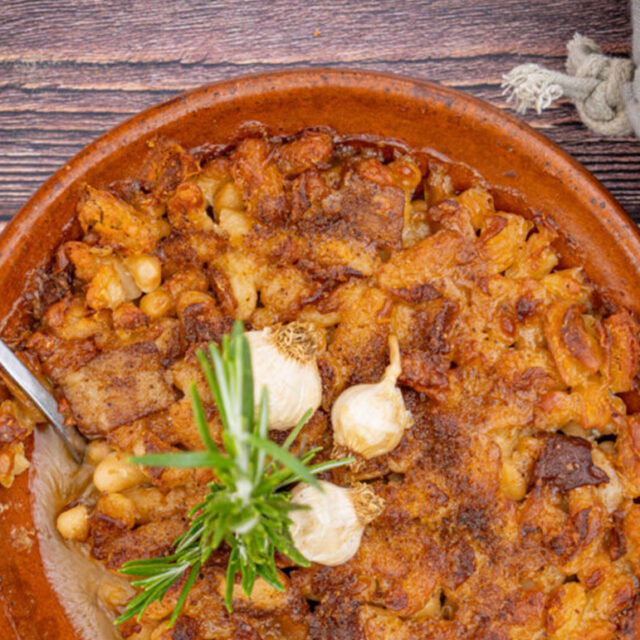
The Clos Fleuri restaurant is on site: homemade cassoulet — lingot beans from the Lauragais, duck confit, cooked in an earthenware cassole from Issel or Mas-Saintes-Puelles (11 and 14 min) — and duck from the Montagne Noire from a local producer.
The reds of the Cabardès and the Malepère grow on the exact land Trencavel and Montfort were fighting over. The Cabardès is the only AOC in France allowed to blend Atlantic and Mediterranean grape varieties — because it sits right on the climatic dividing line, the same one as Naurouze, which you saw on day 1.
It all connects. That’s the point of three days in one place.
What not to do
Don’t aim for Peyrepertuse or Quéribus. They are 1 hr 53 and 1 hr 54 from the Clos Fleuri, that is nearly 4 hours of driving there and back, plus two steep, exposed climbs. Over three days, that’s an entire day sacrificed to the car.
If you really insist: do one of them, leaving at 8 a.m., and drop Montségur. Or plan a night on location.
Don’t do three days of ruins back to back. Break them up with the canal or the Saint-Ferréol lake (25 min). Castles one after another start to blur by the third.
The variant nobody suggests
If the history genuinely interests you, swap half a day for Fanjeaux (19.3 km, 21 min) and Prouilhe (16.3 km, 18 min).
This is where Dominic de Guzmán preached against the Cathars from 1206, and where he founded his first monastery — the order that would supply the Inquisition in 1233. It’s the other side of the story, and it’s closer to Castelnaudary than any Cathar castle. Nobody stops there.
Do you have any questions?
We’re here to help
Day 1: Castelnaudary and the Canal du Midi (17-minute drive), Day 2: Carcassonne (34 minutes), Day 3: Mirepoix and Montségur (1 hour 10 minutes) or Saissac–Montolieu–Lastours (26 to 52 minutes). Without changing hotels.
Yes. It was in Carcassonne, in 1209, that Trencavel surrendered to Simon de Montfort: without this background, Montségur is nothing more than a ruin with a lovely view. Visit them in chronological order.
Yes: a 1 hour 10 minute drive, followed by a 30-minute steep climb. It’s closer than its reputation suggests. Allow a full day, including a stop at Mirepoix (38 mins) on the way.
This is not recommended: a 1 hour 53 minute drive, or nearly 4 hours there and back, which takes up one day in every three. Opt for Lastours (52 mins) instead, which is spectacular and leaves you with the whole day.
A total of around 260 km from Castelnaudary: 40 km on day 1, 90 km on day 2, 130 km on day 3. Everything is less than 1 hour 10 minutes from the hotel.