48 hours means one local day and one big excursion. Not two big excursions: that’s 120 km of driving and a weekend spent on the A61.
Here is the itinerary, with the choice to make on Saturday evening — because the second day depends on who you are.
The structure
| Day 1 | Day 2 | |
| Morning | Grand Bassin, town centre, windmill | your big excursion |
| Midday | cassoulet | on location |
| Afternoon | locks, Saint-Papoul | the rest of the excursion |
| Evening | Naurouze, sunset | drive back |
| Driving | ~40 km | 50 to 130 km depending on the choice |
Day 1 — Castelnaudary, with almost no driving
8 a.m. — Grand Bassin (1.9 km, 3 min). Mist on the water, nobody about. 7 hectares, the largest stretch of water on the Canal du Midi. A flat 2.5 km loop, 40 minutes. Then back for breakfast.
9:30 a.m. — Historic centre (1.6 km, 3 min). The Saint-Michel collegiate church, the Notre-Dame-de-Pitié chapel with its 17th-century Baroque interior, and the Lauragais museum in the former Présidial courthouse.
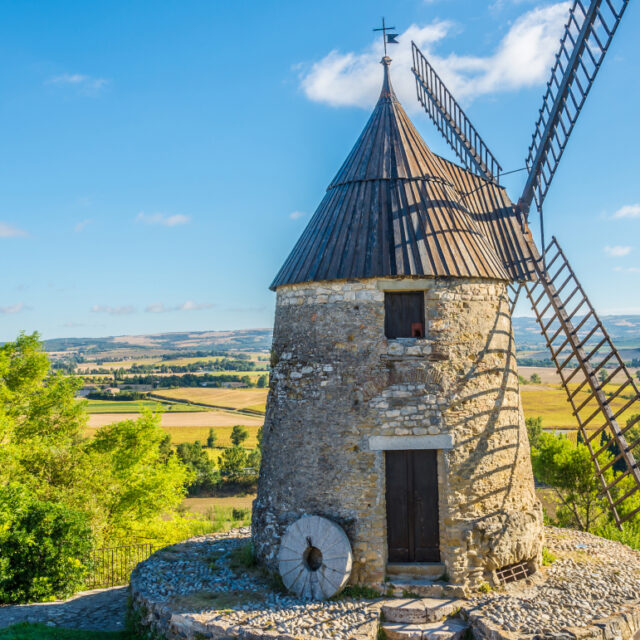
10:30 a.m. — Cugarel windmill (2.2 km, 5 min). The last of the thirty-odd mills of the Lauragais. Views over the plain, the Montagne Noire, and the Pyrenees on a clear day. The final 300 metres climb steeply — you can park at the top.
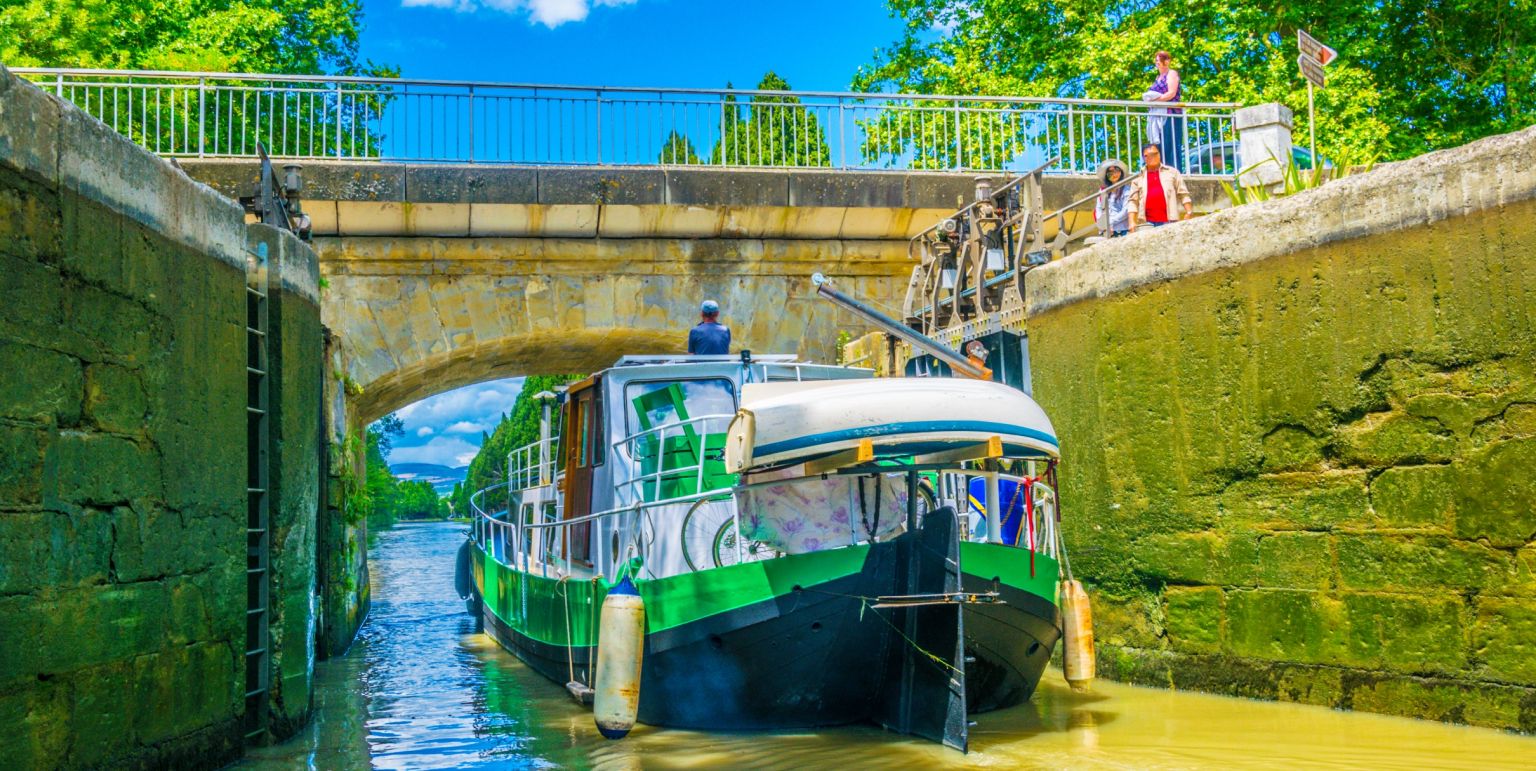
11:30 a.m. — Saint-Roch locks (1.7 km, 3 min). Four chambers, about ten metres. A boat takes 40 minutes to work through them all, and you can follow on foot. The chambers are oval: Riquet curved the walls to put them in compression, which is why they’ve held for 350 years.
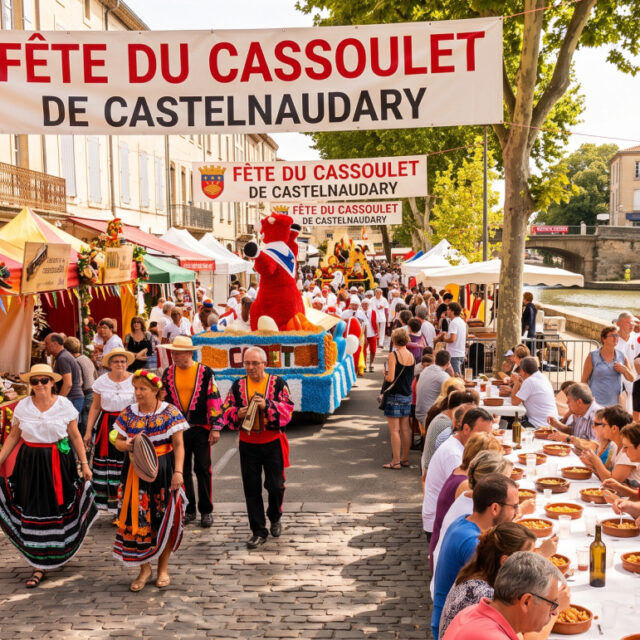
12:30 p.m. — Cassoulet, two hours. Lingot beans from the Lauragais, duck confit, cooked in an earthenware cassole from Issel or Mas-Saintes-Puelles (11 and 14 min from here). At the Clos Fleuri restaurant, made in-house, with duck from a producer in the Montagne Noire.
3 p.m. — Saint-Papoul abbey (8.6 km, 10 min). A cathedral from 1317 to 1801, a cloister, and sculptures by the Master of Cabestany.
4:30 p.m. — Naurouze watershed (15.3 km, 17 min). The point where the waters divide, at 189 m. Riquet’s obelisk, the avenue of plane trees.
7 p.m. — Back to the Grand Bassin. The boats moored, the light low. You’ll have seen the same place at 8 a.m. and at 7 p.m.
Day 1 total: 40 km of driving. See What to do around Castelnaudary in 24 hours.
Day 2 — The choice
This is where the weekend is decided. Four options, pick one.
| Option | Round trip | Who it’s for |
| A — Carcassonne | ~90 km | first visit, heritage |
| B — Montagne Noire | ~50 km | nature, families, hot weather |
| C — Cabardès | ~70 km | wine, villages, slow pace |
| D — Northern Cathar country | ~120 km | history, walking |
Option A — Carcassonne
43.7 km · 34 min · the default option, and it’s a good one
The only advice that matters: leave at 8:15 and be at the Porte Narbonnaise by 9. At 9 the ramparts are empty; by 11 they’re packed. That’s the whole difference between a medieval city and a corridor of gift shops.
3 km of ramparts, 52 towers, a double curtain wall, UNESCO 1997. The Château Comtal and the space between the two walls (2 hrs — that’s where the defensive system makes sense), the Saint-Nazaire basilica with its 13th- and 14th-century stained glass (free, 30 min), the back lanes off the main axis, the descent through the Porte d’Aude and the Pont Vieux (the best viewpoint, and free), and the Bastide Saint-Louis.
The car-free alternative: the regional train takes 20 minutes from Castelnaudary station (2.4 km, 5 min from the hotel). You arrive in the Bastide, so you walk up through the Porte d’Aude — the right way round. And you can have a drink with lunch.
See What to do in Carcassonne in one day.
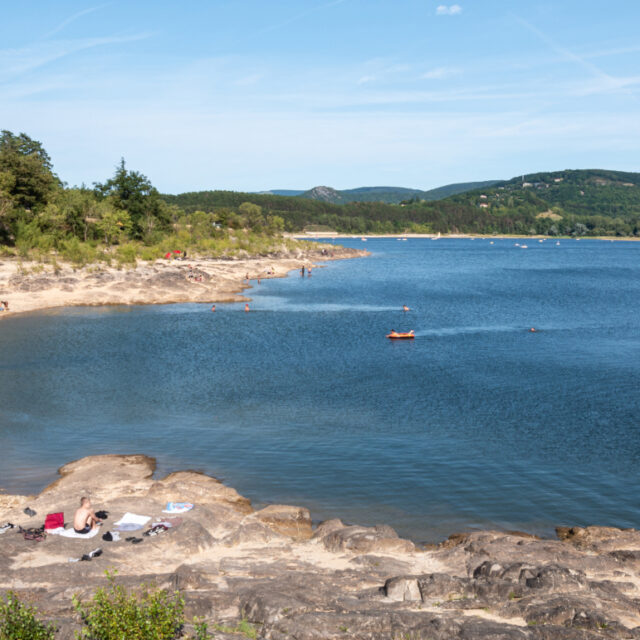
Option B — The Montagne Noire and Saint-Ferréol lake
21.6 km · 25 min · the best option in summer and with children
When the Lauragais is at 36 °C, the Montagne Noire is at 28. And the lake means you can swim — which the Canal du Midi does not.
What nobody tells you: Saint-Ferréol isn’t a lake. It’s the reservoir of the Canal du Midi, dug between 1667 and 1672, at the time the largest hydraulic structure in Europe. The canal peaks at 189 m at Naurouze — which you saw yesterday — and there is no water at that altitude. Riquet came here to find it.
The day: a loop of the lake (5 km, 1 hr 30) in the morning, a picnic in the park below the dam — the part everyone misses — and swimming in the afternoon (lifeguarded in season). Add Revel (22.6 km, 24 min) and its medieval timber-framed market hall.
Total: 50 km over the day. It’s the most restful option.
See Saint-Ferréol lake.
Option C — Saissac, Montolieu and the Cabardès
23 to 34 min · the slow option
9 a.m. — Château de Saissac (23.1 km, 26 min): a ruined fortress overlooking the plain of the Lauragais, a former Trencavel stronghold. The best view-to-distance ratio in the region, and nobody talks about it.
11:30 a.m. — Montolieu (26.9 km, 34 min): the book village. Bookshops and workshops in a village of fewer than 800 inhabitants. Lunch there.
3 p.m. — Tasting in the Cabardès. The only AOC in France allowed to blend Atlantic grapes (merlot, cabernet) with Mediterranean ones (syrah, grenache) — because it sits right on the climatic dividing line, the same one as Naurouze. Domaine de Cabrol in Aragon, Cave des Oliviers in Montolieu, Les Vignerons de la Voie Romaine in Pezens.
Call ahead, and nominate a driver. See The wine route around Carcassonne.
Option D — Saissac and Lastours
26 to 52 min · for walkers
Saissac in the morning, the castles of Lastours in the afternoon (58.8 km, 52 min): four fortresses on a single rocky ridge. Cabaret held out against Simon de Montfort; the Régine tower was built by the victor. Both sides on the same ridge.
A steep 30-minute climb, closed shoes, water, no shade. Set off before 11 a.m. in summer.
See The finest Cathar castles.
Adapting to the season
Spring: every option works. Option C if you like wine. Summer: Option B, without hesitation. And if you’re set on Carcassonne, leave at 8. Autumn: Option C. Harvest, low light, empty sites. The best time of year here. Winter: Option A. Carcassonne under a grey sky with nobody in it is pure luxury.
What not to do
Don’t do two big excursions. Carcassonne on Saturday and Lastours on Sunday adds up to 210 km, two 8 a.m. starts and no time at all for Castelnaudary. You’ll go home more tired than you arrived.
Don’t aim for Peyrepertuse. At 1 hr 53, it’s 4 hours of driving there and back. Over 48 hours, it’s a waste.
Taking the Lauragais home
Before you leave, stop by the market or a producer: lingot beans (they keep), local honey, confit, charcuterie, regional cheeses, and in season Lauragais saffron or walnuts. A cassole from Issel or Mas-Saintes-Puelles too — you won’t make a real cassoulet without one.
Do you have any questions?
We’re here to help
A day out in the local area — Grand Bassin, Cugarel Mill, the Saint-Roch, Saint-Papoul and Naurouze locks, all within 17 minutes — followed by a longer trip: Carcassonne (34 mins), Lake Saint-Ferréol (25 mins) or Saissac and Montolieu (26–34 mins).
It’s possible, but not recommended: two long day trips mean a journey of over 200 km and two early starts, without seeing anything of Castelnaudary. Choose just one.
Lake Saint-Ferréol (25 mins): the Montagne Noire is several degrees cooler than the Lauragais, and this is the only proper place to swim within easy reach — swimming is prohibited in the Canal du Midi.
For the most part. The canal, the town centre and the mill are less than 5 minutes away, and Carcassonne can be reached by TER in 20 minutes from the station, which is 2.4 km from Le Clos Fleuri.
Autumn: the grape harvest in Cabardès and Malepère, low light over the canal, uncluttered landscapes and ideal temperatures for walking.