Castelnaudary lives by two calendars: the weekly market, and the farming seasons. Here is what you will find, when, and how to fit it into a stay.
The weekly market
The Castelnaudary market is held on Monday mornings in the town centre, 1.6 km from Le Clos Fleuri, 3 minutes away. It is where the Lauragais puts itself on display: lingot beans, garlic, local honey, sheep’s and goat’s cheeses, charcuterie, poultry, and seasonal fruit and vegetables.
Practical tip: parking in the town centre is harder that morning. Walk in from the hotel if you can, or park on the edge of the centre.
What to buy: the Lauragais lingot bean (the cassoulet one — it keeps), honey, olive oil, and in season Lauragais saffron — a small-scale but very real production, at prices no supermarket can match.
What happens in spring
Spring is the season of plant markets and the first village brocantes. Producers bring out the spring cheeses, the first vegetables, the asparagus. It is also the best time for walking in the hills: the wheat is green, the paths are dry, and it is not yet 35°C.
What happens in summer
The season of car-boot sales and evening markets. The villages of the Lauragais hold their brocantes on Sunday mornings, and several communes run producers’ markets in the evening — you eat there, at the producer’s own table.
It is also the season of village fêtes votives: dances, meals, entertainment. They are not announced far in advance and change every year; ask locally.
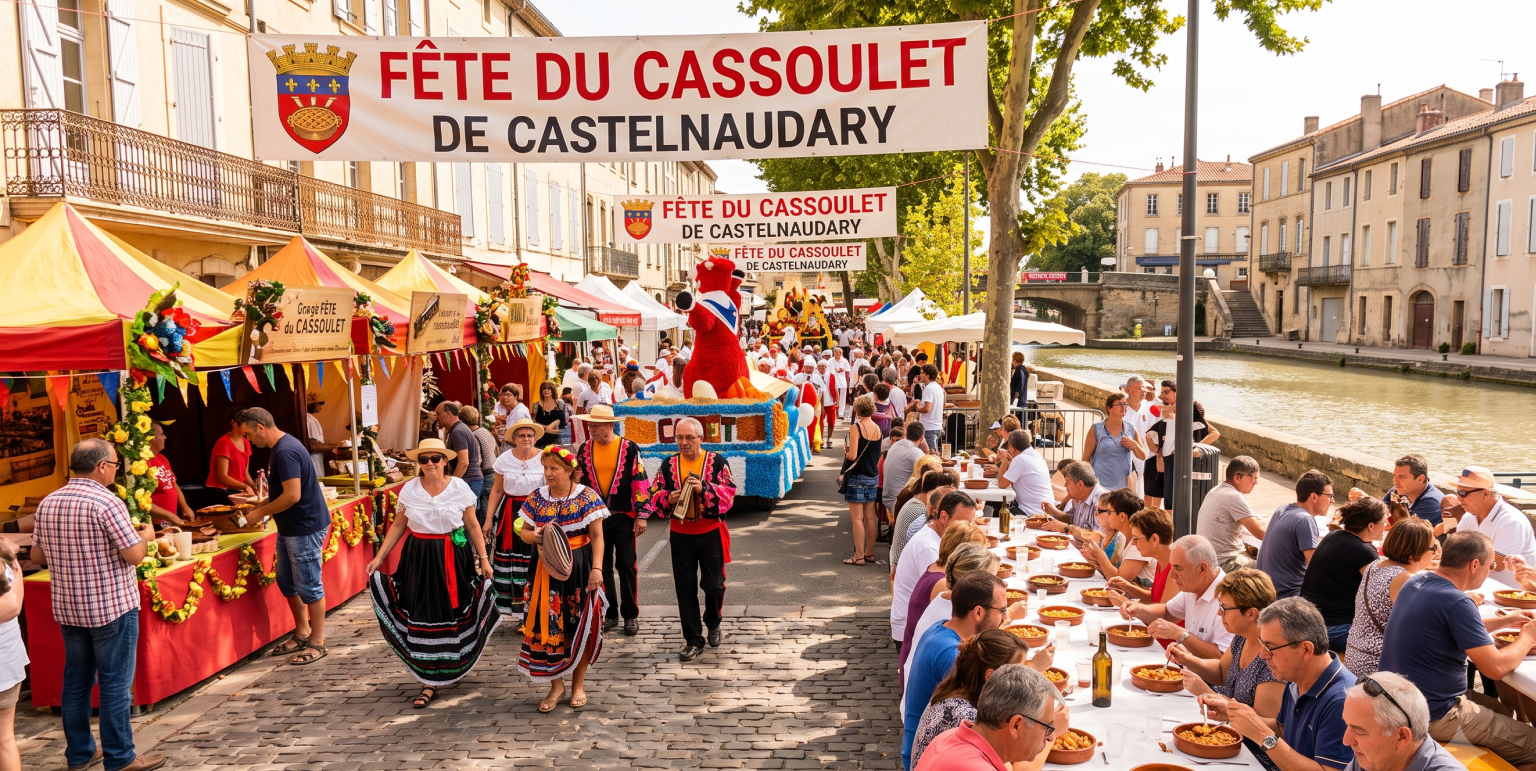
The highlight: every summer Castelnaudary devotes a major festival to cassoulet, with a parade, entertainment and a giant meal. It is when the town is at its liveliest — and when a room is hardest to find. If you are aiming for that period, book early.
What happens in autumn
The best season for food. This is the time of the grape harvest in the Cabardès and the Malepère, of wine fairs, and of the return of keeping produce: walnuts, confits, foie gras, and chestnuts from the Montagne Noire.
Lauragais saffron is harvested in October and November: a few producers open their doors during the flowering. It is short, it is little known, and it is worth the detour.
Autumn is also the best time to visit the region generally: low light, uncrowded sites, and ideal temperatures for walking.
What happens in winter
The season of duck and truffles. The marchés au gras set up in the villages of the Lauragais and the Montagne Noire; you will find foie gras, duck breasts, confits and charcuterie straight from the producer, at prices unrelated to supermarket Christmas shelves.
Black truffle is traded on a few specialist markets in the area between December and February.
And it is, of course, the real season for cassoulet: a dish that was never designed for August.
Building a stay around these dates
The rule is simple: the market in the morning, the sightseeing in the afternoon. A two-night stay lets you do the market on the first morning, picnic at the Grand Bassin at midday, and keep the afternoon for Saint-Papoul or Naurouze.
From Le Clos Fleuri you are 3 minutes from the centre: you can walk to the market, bring your shopping back, and head out again. And for fresh produce bought in the morning, ask at reception — better than leaving it in a car in full sun.
Dates change every year. Brocantes, village fêtes, fairs and events are not fixed. For the up-to-date programme for your week, check with the Lauragais Audois Tourist Office.
Got a question?
We are here to help
At the weekly market, direct from Lauragais producers, and in the town-centre shops. See Markets and local producers around Castelnaudary.
From the Lauragais Audois Tourist Office, which keeps the up-to-date calendar. Brocante and village fête dates change every year.
Read also: Markets and local producers around Castelnaudary · A gourmet break in the Aude · The vineyards around Castelnaudary