You are about to visit some spectacular ruins and wonder, by the third castle, what exactly it all means. Here is the essential background — including the three things the tourist signage does not tell you.
Three things to know before you go
- The Cathars never called themselves Cathars. They said “good Christians”, “good men”, “good women”. The word “Cathar” comes from their opponents, in the 12th century.
- The Cathars built no castles. Theirs was a religious movement, not a military power. They were given shelter in the castles of local lords who were not, as a rule, Cathars themselves.
- Most of the walls you see were built after the crusade — by the winner. The “Cathar castles”, in their present state, are royal frontier posts aimed at Aragon. Not at the Cathars, who no longer existed.
None of these three facts spoils anything. They turn the visit from “nice view” into “now I understand what I am looking at”.
Who were they?
A dualist form of Christianity, rooted in 12th-century Languedoc. The central idea: the material world is the work of evil, the soul is imprisoned in matter, and salvation means setting it free.
Two levels: – The perfecti (or good men), a minority, who had received the consolamentum. An ascetic life: no meat, no possessions, no sex. They preached and lived by their own labour. – The believers, the great majority — ordinary people, who received the consolamentum as they were dying.
Why it took hold here: because these people lived poorly, by working, in the midst of a rich and distant Roman Church. The comparison was brutal, and everyone made it.
Why a crusade?
In January 1208, the papal legate Pierre de Castelnau was murdered. The Count of Toulouse was suspected. Innocent III preached a crusade — the first against Christians, on Christian soil.
What followed was not only religious. The northern barons saw an opportunity: land to be taken, with the Pope’s blessing. Faith was the motive; conquest was the engine.
1209 — Béziers. The town was taken and massacred. That was the opening act, and it set the rule.
August 1209 — Carcassonne. After a two-week siege, Raymond-Roger Trencavel surrendered. He died in captivity three months later, aged 24. Simon de Montfort inherited the viscounty.
This is where it all begins. That is why you should visit Carcassonne first, 34 minutes from Le Clos Fleuri.
What happened 20 minutes from here
Here is the part nobody tells, and it took place around Castelnaudary.
1210 — Bram (16.8 km, 18 minutes). The village was taken. Simon de Montfort had around a hundred prisoners mutilated — eyes put out, noses and lips cut off — and sent them towards Cabaret, at Lastours, in single file, led by one man left with a single eye. It was a message, and it was received.
Today Bram is a circulade — a village built in concentric rings, one of the best preserved in Languedoc — and it is a peaceful place.
September 1211 — Castelnaudary. Simon de Montfort was besieged here by Raymond VI of Toulouse. It was one of the rare moments when he came close to losing. The battle of Castelnaudary is a major episode of the crusade, and it was fought under your feet.
1210 — Minerve (99.9 km, 1 hr 18). After a siege, 140 perfecti refused to recant. They walked to the pyre. It was the first mass burning of the crusade.
There is nothing to visit at Bram or in Castelnaudary. But you are not in a region where history happened somewhere else.
How it ends
1229 — Treaty of Meaux-Paris. The county of Toulouse passed under the control of the crown. That is the real reason behind the whole affair: Languedoc, independent for as long as anyone could remember, became French.
1233 — The Inquisition. Entrusted to the Dominicans. The war was over; the hunt began, and it would last a century.
March 1244 — Montségur (64 km, 1 hr 10). After almost a year of siege, the fortress surrendered. Around two hundred perfecti refused to recant and were burned at the foot of the pog, at the prat dels cremats. That was the military end.
1255 — Quéribus. The last stronghold. After that, there was nothing left to take.
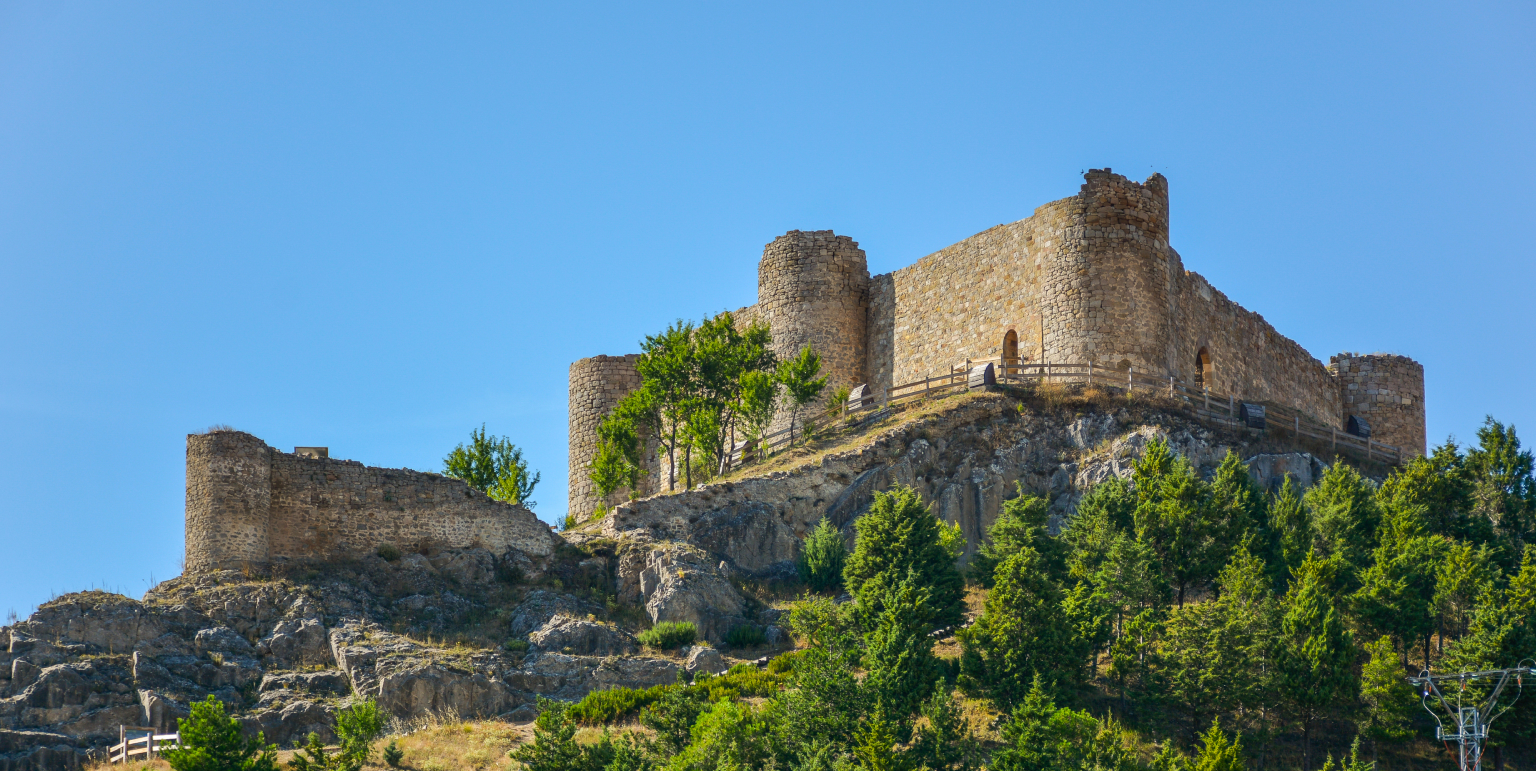
1258 — Treaty of Corbeil. The border with Aragon was fixed. The King of France then fortified Aguilar, Peyrepertuse, Puilaurens, Quéribus and Termes — the five sons of Carcassonne — to hold that line.
This is the key point of the whole article: these five fortresses, the most famous in “Cathar Country”, were built against Spain, after the Cathars had disappeared. They became useless in 1659, when the Treaty of the Pyrenees moved the border 100 km further south.
So they never served the purpose people come to see them for.
The other camp, 20 minutes away
Prouilhe — 16.3 km, 18 minutes. In 1206, Dominic de Guzmán founded a community here to take in converted women. It is the birthplace of the Dominican order.
Fanjeaux — 19.3 km, 21 minutes. The hilltop village from which he preached, face to face with the Cathars. The view reaches the Pyrenees.
Dominic spent a decade trying to persuade through words and poverty — the only method that could work, since it was the example of the perfecti that won people over. The crusade solved the problem another way. And the order he founded would supply, twenty years after his death, the inquisitors.
This is the other side of the story, and it is closer to Castelnaudary than any Cathar castle. Almost nobody stops there.
The way to look at it
When you are at the top of Lastours (52 min), look at the Tour Régine: it postdates the capture of the site. The King of France built it on the ridge where Cabaret had held out. The two camps, fifty metres apart.
When you are at Montségur (1 hr 10), remember that these walls are not the walls of the siege. The castrum was razed; what stands is a royal rebuild. The place is real, the stones are not.
When you are at Peyrepertuse (1 hr 53), know that you are looking at an anti-Aragonese structure from the late 13th century, and that no Cathar ever set foot in it.
It is more interesting than the legend. The legend is pretty; the history is dizzying.
From Le Clos Fleuri
You are at the centre of all this, and that is why the region is best visited from here: Prouilhe 18 min, Bram 18 min, Fanjeaux 21 min, Saissac 26 min, Carcassonne 34 min, Mirepoix 38 min, Lastours 52 min, Montségur 1 hr 10.
The order that makes sense: Carcassonne first (the context), Lastours next (both camps on the same ridge), Montségur last (the end). And if you have half a day to spare, Fanjeaux and Prouilhe — the opposing camp, the one nobody talks about.
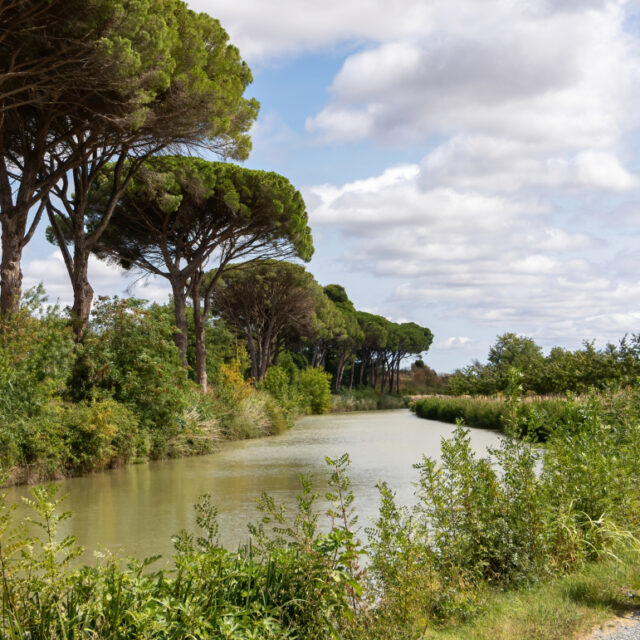
In the evening, the restaurant at Le Clos Fleuri is three minutes from the Canal du Midi and no minutes at all from your room. The cassoulet is handmade, the duck comes from a producer in the Montagne Noire, and the reds of Cabardès and Malepère grow on the land Trencavel and Montfort fought over.
To go further, the sites have interpretation centres and guided tours whose arrangements change. Check before your visit.